Lawn Care in South Surrey
We are based here. South Surrey is where the majority of our routes run, and where we know the soil, the slopes and the strata rules street by street.
Go Green Mowing operates out of South Surrey, and this is the community where most of our weekly routes run. That matters more than it sounds: a lawn care company that is genuinely local is on your street every week anyway, which means smaller travel windows, easier reschedules when the rain does not cooperate, and crews who already know that the north side of your house behaves nothing like the south.
South Surrey is not one landscape. A new build in Grandview Heights sits on thin builder topsoil spread over compacted subsoil. An older property in Ocean Park sits under mature conifers with root competition and deep shade. An acreage in Elgin Chantrell has drainage running toward the Nicomekl floodplain. These need different programs, and we quote them differently.
South Surrey areas we serve
Why South Surrey soil is the real problem
Most lawn complaints we get in South Surrey trace back to the same place: glacial till subsoil that drains slowly, sitting under a shallow layer of topsoil. When more than 1,000 mm of rain falls on that between October and March, the root zone stays saturated for months. Grass roots need oxygen. Saturated clay does not supply it, so the turf thins out — and moss, which is perfectly happy in those conditions, takes the space.
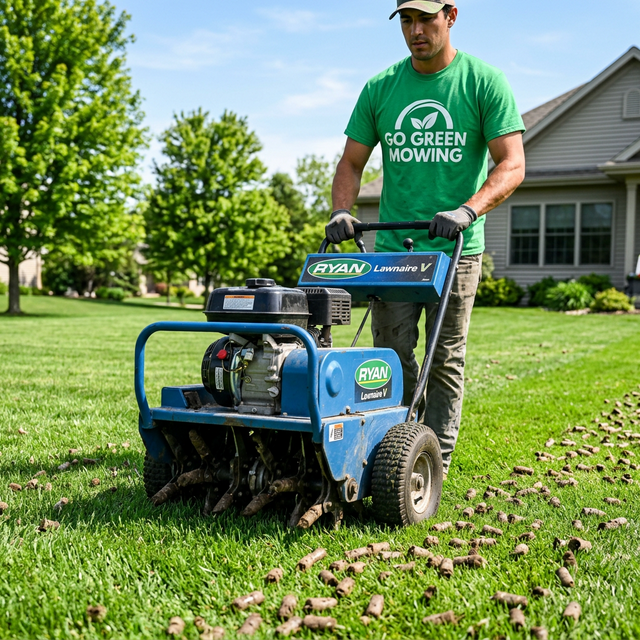
This is why we push core aeration harder in South Surrey than we would in a drier region. Aerating pulls physical plugs out of the profile and gives water and air somewhere to move. On the newer subdivisions in Grandview Heights and Morgan Heights the problem is worse, because the subsoil was driven over by heavy equipment during construction and then covered with a few inches of imported topsoil. Those lawns look fine for two years and then stall out.
The fix is not more fertilizer. Feeding grass that cannot get oxygen to its roots does very little. The sequence that works here is power rake, aerate, overseed, then feed — in that order, in one spring visit.
Shade, conifers and the Ocean Park problem
The older, treed parts of South Surrey — Ocean Park, Crescent Park, parts of Elgin — have beautiful mature Douglas fir and cedar and lawns that will never be lush underneath them. Two things are happening at once: the canopy is blocking the four to six hours of direct light most turfgrass needs, and the tree roots are outcompeting the grass for water and nutrients in the top few inches of soil.
We would rather tell you this up front than sell you a treatment program that cannot work. Under a dense conifer canopy the honest options are overseeding with a shade-tolerant fine fescue blend and accepting a thinner lawn, selectively thinning the canopy to let light through, or converting the area to a shade planting or mulched bed. All three are legitimate. Repeatedly reseeding a deep-shade lawn with sun-grass is not.
Strata and townhouse properties
A large share of newer South Surrey housing is strata — the townhouse complexes around Morgan Crossing, Morgan Heights and Grandview Corners in particular. Strata grounds work has requirements a detached-home route does not: proof of liability insurance and WorkSafe BC clearance on file with the property manager, scheduled service windows that do not conflict with resident parking, consistent standards across every unit so nobody is comparing their strip to their neighbour's, and one point of contact rather than thirty.
We carry full liability coverage and WorkSafe BC clearance and can provide documentation to a strata council or property manager before work starts. We also quote strata common areas as a fixed seasonal contract rather than per visit, which is usually easier for a council to budget against.
What our South Surrey calendar looks like
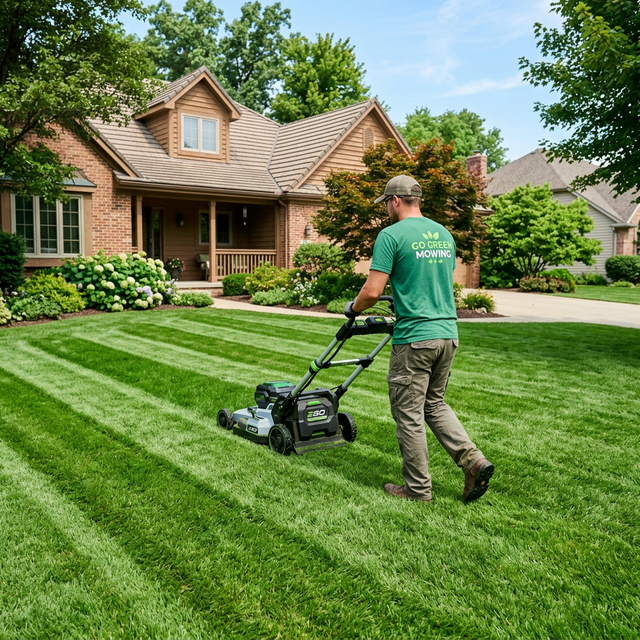
March is power raking and moss control, because that is when the winter moss is at its peak and the soil is finally workable. Late March into April is core aeration and overseeding, timed so seed goes down while the soil is warming but the spring rain is still reliable. Weekly mowing starts in April and runs at its tightest through May and June, when growth here can exceed an inch a week. July and August we typically move to every seven to ten days and raise the cut height to conserve soil moisture.
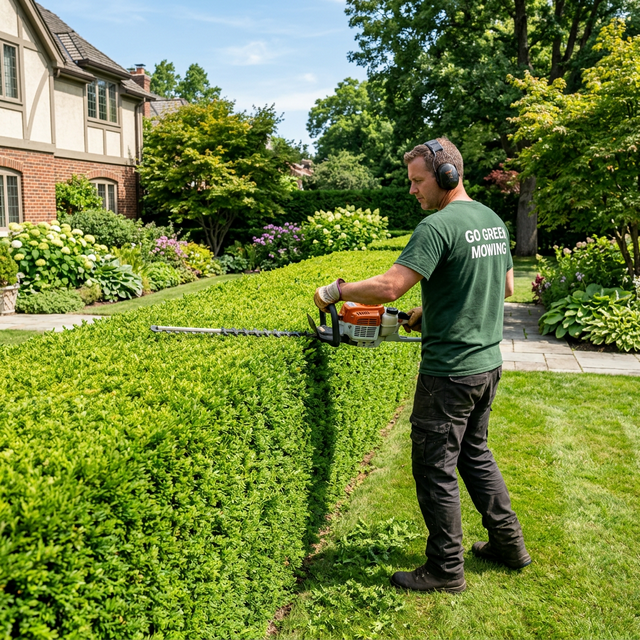
Hedges get their main trim in late June or early July. September is the most valuable fertilizer application of the year and the last safe window for hedge shaping. October through November is leaf clearing, and the final low mow — done late enough in November that the leaves have actually finished falling.
Jobs around South Surrey
Services that matter most in South Surrey
South Surrey lawn care questions
Do you serve all of South Surrey?
Yes. We run routes across Grandview Heights, Morgan Creek, Morgan Heights, Ocean Park, Crescent Beach, Elgin Chantrell, Sunnyside Park, Rosemary Heights, Douglas and Hazelmere. South Surrey is our home base, so it has our densest coverage and our shortest scheduling windows.
How much does lawn mowing cost in South Surrey?
Roughly $45 to $85 per visit for a typical South Surrey residential property in 2026. Townhouse and small lots run $40–$55, standard detached lots $55–$75, and properties over a quarter acre $85–$150 or more. That covers mowing, line trimming, blowing off hard surfaces and grasscycling the clippings. We quote a fixed per-visit price after seeing the property, with no trip or fuel surcharges.
Why does my South Surrey lawn grow so much moss?
Because local conditions favour moss over grass for about five months a year: over 1,000 mm of annual rain concentrated in winter, slow-draining glacial till subsoil, low winter light, shade from mature conifers, and acidic soil around pH 5.0–5.5 when grass wants 6.0–6.5. Moss does not kill grass — it fills space thin, oxygen-starved turf has already given up. Fixing it means addressing compaction and light, not just applying moss killer.
When should I aerate my lawn in South Surrey?
Late March through April is ideal — the soil is moist but no longer waterlogged and the grass is entering active growth. September is the second-best window. Avoid aerating in summer heat, in the waterlogged depths of winter, or during drought.
Do you work with strata properties and property managers?
Yes. We carry full liability insurance and WorkSafe BC clearance and can supply documentation to a strata council or property manager before work begins. Strata common areas are quoted as a fixed seasonal contract rather than per visit, which is generally easier for a council to budget.